Last November we installed a door on a house up near Mt. Bachelor Village — beautiful place, sits at about 6,200 feet, backs up to nothing but trees and wind. The homeowner had bought a wood door from some outfit out of Portland. Gorgeous door, honestly. Looked incredible for about fourteen months. Then it started checking. Deep cracks, right along the grain, because nobody told this guy that a clear-finished softwood door at 6,200 feet in Central Oregon is basically a science experiment in UV degradation. He called us to fix it but the panels were too far gone. We ended up tearing the whole thing out and putting in a CHI 5217 carriage house — steel core, faux wood overlay — and it still looks brand new.
That job is why I wanted to write this. I've been installing garage doors across Bend and the surrounding areas since 2016, and the single biggest mistake I see people make is choosing a door based on how it looks in a catalog without thinking about what the high desert is going to do to it. So this is me — Tyler — giving you the straight version of what actually works up here and what doesn't. No fluff. Just ten years of watching doors succeed and fail in this climate.
Steel Doors Run This Town (and That's Not Changing)
I put in a lot of steel doors. Probably 80% of what we install across Bend is some version of insulated steel, and there's a dead simple reason — they just work. No warping when it hits 100 in July. No cracking when it drops to 10 in January. You wash it once a year and forget about it. Try that with wood.
The way these doors are built matters though, and I want to get into this because not all insulated steel is the same. The doors I recommend use two steel skins — typically 25-gauge or 24-gauge — with polyurethane foam injected between them under pressure. That foam bonds to both steel faces, which makes the whole panel rigid, quiet, and thermally efficient. You'll also see polystyrene insulation in cheaper doors. That's the white foam board that's just dropped in between the panels. It works okay when it's new, but I've pulled apart older polystyrene doors in Bend and found the foam has shrunk — sometimes a quarter inch or more — leaving air gaps around the edges. Our freeze-thaw cycles do that over time. Polyurethane doesn't shrink. Spend the extra fifty or sixty bucks and get the polyurethane. Every time.
For specific models, the CHI 4216 and 4217 are what we install most. R-16 insulation, really clean panel profiles, and they come in enough colors and styles that you can match just about any house. The 2200 series from CHI is a step down in price — still polyurethane, still solid — if you're watching the budget. On the Clopay side, look at the Classic Collection Premium Series with their Intellicore insulation. Amarr's Stratton line is another good option at a lower price point, though the fit and finish isn't quite as refined as CHI or Clopay. I'm being honest about that — it's a fine door, it just doesn't feel as premium when you're standing next to it.
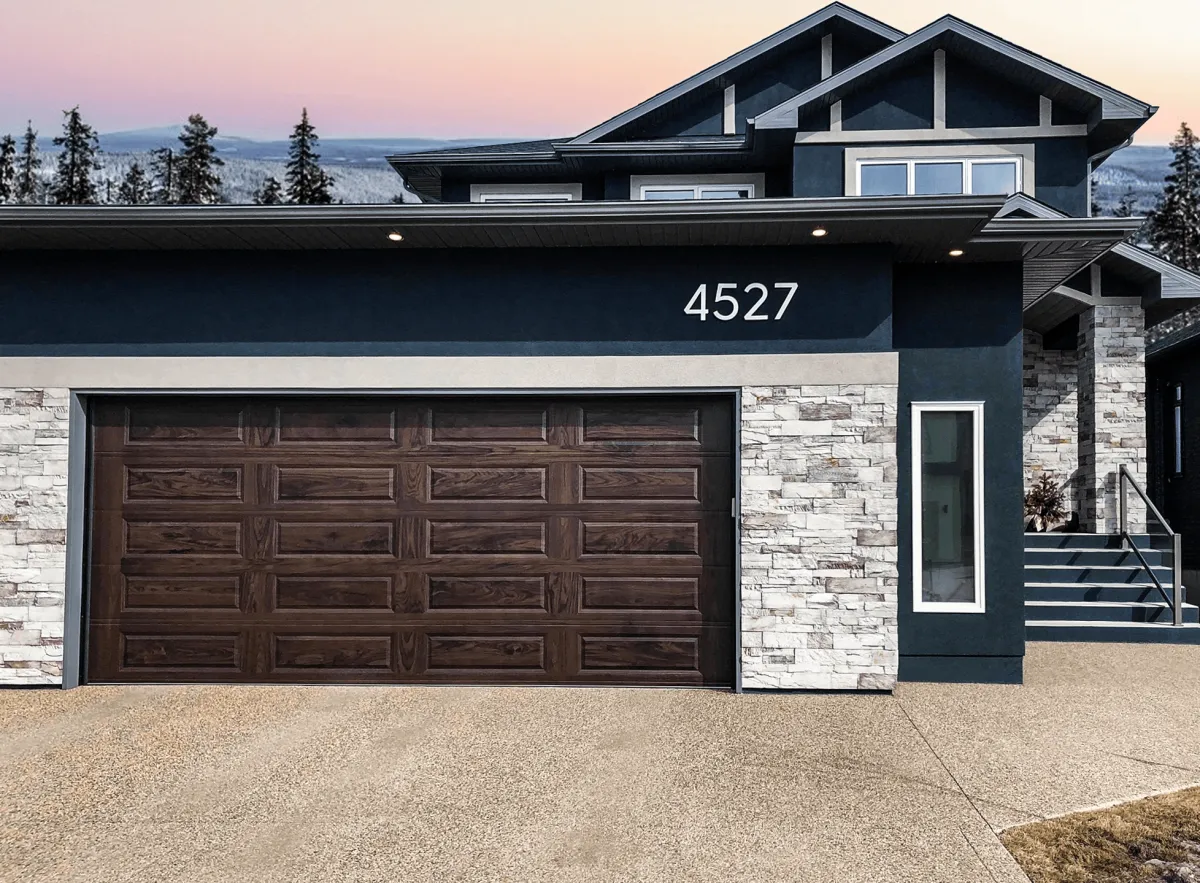
One more thing on steel doors that I don't think gets talked about enough: dent resistance. A 25-gauge steel door can take a basketball, a wind-blown branch, even a careless kid on a bike, and you won't see it. Drop down to 27-gauge or 28-gauge (cheaper doors from big box stores) and you'll dent it carrying in groceries. I've seen it happen. Gauge matters.
Carriage House Doors — Where Bend's Taste Meets Reality
Drive through Broken Top, NorthWest Crossing, Awbrey Butte, or Tetherow and count the carriage house doors. I'll wait. They're everywhere, and I'm not complaining — I think they're the best-looking residential door style out there when they're done right. The trick is getting that handcrafted wood look without actually using wood, because wood and Central Oregon have a complicated relationship (more on that below).
The carriage house doors I install are steel underneath. Same sandwich construction I just described — two steel skins, polyurethane core — but with decorative overlays on the exterior face that mimic plank-style wood doors, barn doors, or traditional carriage entries. CHI's Overlay Carriage House series is what we put in most often. The 5216, 5217, and 5283 are the models you'll see on my truck. They come in stain finishes — walnut, cedar, dark mahogany — that honestly fool most people. I've had neighbors ask homeowners where they got their "wood" door.
Clopay's Canyon Ridge collection is the other one I reach for, especially on higher-end builds. These use a faux wood composite material over the insulated steel frame, and the texture is more three-dimensional than most overlays. I've got Canyon Ridge doors I installed seven, eight years ago in Awbrey Glen that still look fantastic. No refinishing, no touch-up, nothing. Just hose them down occasionally.
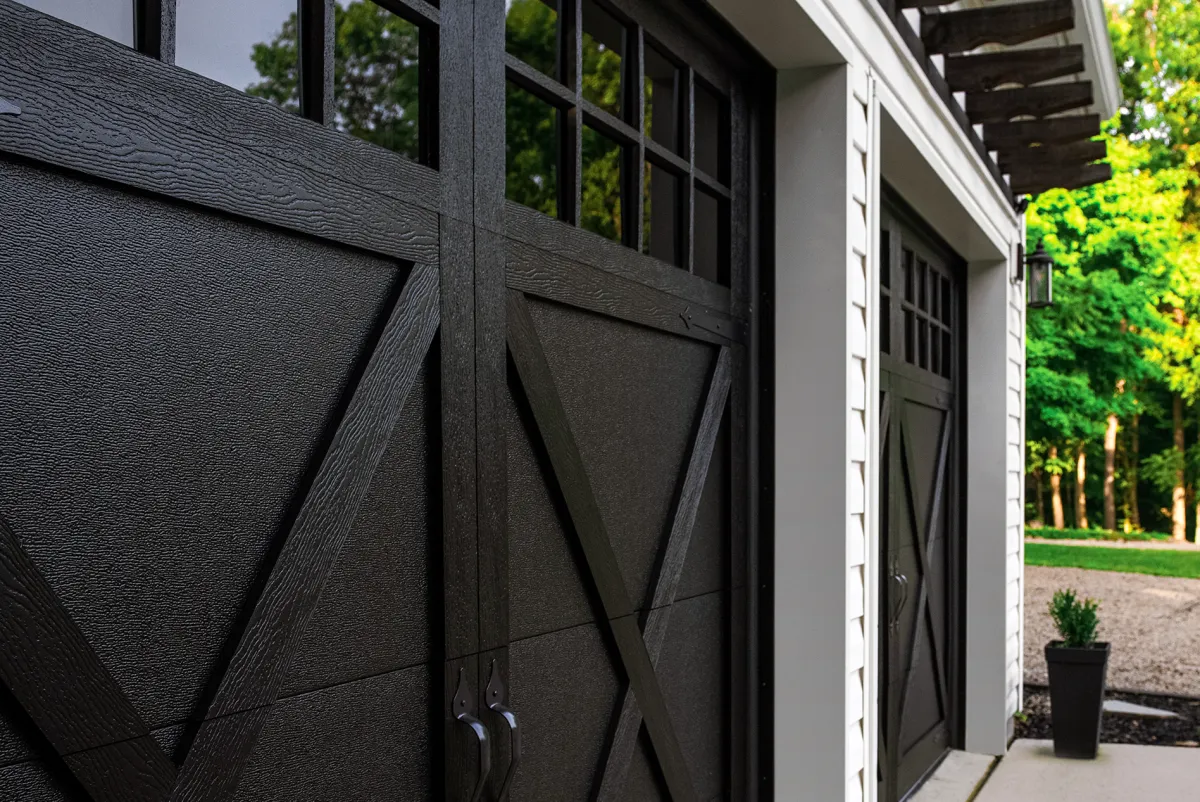
A side note on HOAs, because this comes up constantly. If you live in a planned community in Bend — and a lot of people do — your CC&Rs almost certainly have guidelines about garage door style, color, and sometimes material. Carriage house doors in earth tones or wood-grain finishes satisfy basically every HOA I've worked with. But check before you order. I've seen people fall in love with a contemporary flush-panel door, order it, and then find out their architectural review committee won't approve it. We've worked with most of Bend's HOAs at this point and can usually tell you what'll fly and what won't before you even submit paperwork.
The Rest of the Lineup
I don't want to spend equal time on every door type because the reality is, steel and carriage house cover about 90% of what we install. But the other 10% matters, so let me run through it.
Full-view aluminum and glass doors are showing up more and more, especially on the modern builds popping up on the east and south sides of town. These are the ones with the aluminum frame and rows of glass panels — clear, frosted, tinted, whatever you want. Frosted glass is what we install most because it lets light in but keeps your mess private (let's be real, most garages aren't showrooms). CHI's Full-View series and Clopay's Avante collection are both good. I typically push people toward dark bronze or black frames — they look great against Bend's landscape and they don't show dust and pollen the way silver or white frames do.
I'll be blunt about the trade-off though. Even with double-pane insulated glass, a full-view door doesn't insulate anywhere near as well as a steel sandwich door. If your garage is attached and you care about your heating bill, that's a real consideration. For a detached shop or a studio space where you want natural light? Go for it. For an attached two-car garage that shares a wall with your living room? Think hard.
Real wood doors. They're beautiful. I won't pretend otherwise. A genuine cedar or redwood door on a custom home in Shevlin or along the Deschutes — there's nothing like it. But I need to be straight with you: real wood in this climate is a commitment. Our UV is intense (high altitude, 300 days of sun), our humidity swings are massive (bone dry in August, saturated in March), and freeze-thaw cycles do a number on any organic material. You're looking at refinishing every two to three years, minimum. Skip it and you'll have cracking, warping, and graying within a couple of seasons. I've seen $8,000 wood doors look terrible in under four years because the homeowner didn't keep up with the finish.
If you're set on wood — and some people are, and I respect that — go with Western Red Cedar. It's naturally rot-resistant and handles moisture swings better than most species. Redwood is gorgeous too but harder to source and more expensive. Or look at Clopay's Reserve Collection, which uses real wood over a composite substrate. You get the look and feel of solid wood but with dramatically better resistance to the elements. That's the direction I steer most wood-door customers these days.
Commercial and roll-up doors are a different animal entirely. Bend has a ton of shops, pole barns, and flex spaces, and these need doors built for heavy daily use — not curb appeal. We install a lot of CHI's commercial insulated sectional doors in these applications. For pure storage where ceiling space is tight, coiling roll-up doors are the way to go. If you're building a new shop, call us before framing starts — we can help your builder spec the opening correctly so you don't end up with a header that's too small or a rough opening that's a half inch off. Happens more than you'd think.
Insulation, Weather Seals, and the Stuff Nobody Thinks About Until January
Okay, this section isn't glamorous but it might be the most important thing in this entire article. Your door's R-value, its weather seals, and its springs are what determine whether your garage is livable in a Bend winter or basically an outdoor room with a roof.
R-value first. Quick primer if you're not familiar: R-value measures thermal resistance. Higher number = better insulation. For Bend, my recommendations break down like this:
| R-Value | Best For | My Take |
| R-6 to R-9 | Detached garage, vehicle storage only | Bare minimum. Fine if you don't spend time in there. |
| R-12 to R-13 | Attached garage, moderate use | Decent. You'll feel the difference from uninsulated on cold mornings. |
| R-16 to R-18 | Attached garage, workshop, gym, living space above | What I recommend for most Bend homes. This is the sweet spot. |
We've measured the difference. On a 15-degree morning in January, an attached garage with an R-16 door will be 20 to 30 degrees warmer than the same garage with an uninsulated door. That's not marketing — that's a thermometer. If you've got a bedroom above your garage or a living room sharing a wall with it, that temperature difference directly affects your comfort and your heating bill.
But — and this is where I disagree with most of what you'll read online — the door's R-value is only part of the picture. Maybe not even the biggest part. The seals around the door matter just as much, maybe more. I don't care if you've got an R-18 door if there's a half-inch gap at the bottom letting cold air pour in. And I see that constantly. So let me walk through what proper weather sealing looks like.
The bottom seal (we call it the astragal) needs to be a dual-contact or bulb-type rubber seal that conforms to your concrete. Why? Because garage floors in Bend aren't flat. Frost heave shifts them. They crack, they settle unevenly. A rigid seal won't make full contact. You need something flexible that squishes down and fills the gaps. Side seals run vertically along both jambs and block wind-driven rain and snow from blowing in through the edges — this is a bigger deal than people realize when you're getting a 40 mph east wind. Top seal across the header prevents dripping from snowmelt. And the section joints between each panel need tongue-and-groove interlocks, not simple butt joints. Cheap doors have butt joints. You can hear the wind whistling through them.
I should mention — we replace weather seals more than almost any other component. Bend's UV eats rubber and vinyl faster than you'd see in Portland or Eugene. Even quality seals need replacing every five to seven years up here. We use UV-resistant materials specifically for this reason, but nothing lasts forever at 3,600 feet with 300 sunny days a year.
Springs, Wind, and the Things That Break
Your garage door springs are doing all the real work. The opener just nudges the door — the springs counterbalance the entire weight, which on a two-car insulated door can be 150 to 200 pounds. Cold weather is murder on springs. Metal contracts, tension changes, stress on the coils increases. Our spring failure calls spike every single winter. November through March is basically spring season for us — and not the fun kind.
On every new installation, we use galvanized torsion springs rated for 15,000 cycles minimum. Most doors from the big box stores come with 10,000-cycle springs. That might sound like a lot, but if you're opening your garage door four times a day, you're burning through 10,000 cycles in about seven years. The galvanized coating matters too — it resists the corrosion that our freeze-thaw moisture cycling causes on bare steel springs. I've pulled corroded springs off doors that were only five years old because the builder used the cheapest hardware they could find. We also upsize our spring calculations slightly to account for cold-weather resistance. A spring that's perfectly balanced at 70 degrees is going to be too tight at 15 degrees because the metal has contracted. We build that into the math. If you ever need spring replacement, we handle the sizing properly.
Wind is the other thing. The high desert doesn't mess around — sustained gusts of 40 to 60 mph are normal, and if you're out toward Tumalo, near Smith Rock, or on the exposed east side of Bend, it can be worse. Strong wind creates positive pressure on the front of the door that can bow panels inward, stress the tracks, and in a really bad event, blow the door right in. We spec wind-load reinforcement — internal struts and heavier gauge steel — for any home in an exposed location. Most of the premium insulated doors already have decent wind resistance because of their sandwich construction, but we verify it every time and add reinforcement when the site calls for it.
For ongoing maintenance — lubrication, balance checks, hardware inspection — that's something we offer as a scheduled service and honestly it's the single best thing you can do to extend the life of your door and avoid surprise breakdowns. But that's a topic for another article.
Choosing a Door (Without Overthinking It)
I talk to people all the time who are paralyzed by options. Fifteen styles, eight colors, three insulation levels, two brands, custom vs. standard size — it gets overwhelming. So let me simplify it the way I do when someone calls me.
First question: attached or detached garage? If attached, you need R-16 minimum with polyurethane insulation and proper weather sealing. Non-negotiable. If detached and you're just parking cars in there, you can get by with R-9 to R-12 and save some money.
Second question: what style fits your house and neighborhood? This usually narrows it to two or three options fast. Ranch-style home in a standard subdivision? Raised panel or flush panel insulated steel. Craftsman or lodge-style in one of the nicer neighborhoods? Carriage house. Modern build? Full-view or flush panel in a dark finish. Custom home with a specific architect's vision? We'll figure that out together.
Third question: what's the opening size? Most single-car garages in Bend are 9x7. Most two-car garages use a single 16x7 door, though newer builds are going to 16x8 for the extra headroom (nice if you drive a truck). Older homes in the Old Bend neighborhoods sometimes have 8x7 openings. We measure every single one because even a half inch matters for fit and seal — never assume your opening is standard. And if you've got RVs, boats, snowmobiles, ATVs (this is Central Oregon, so... probably?) you might need a 10x8, 10x10, or even bigger. If you're building new, talk to us before framing goes up so the opening is sized right.
Some people ask about doing two single doors instead of one double on a two-car garage. It costs more, but it looks better on the right house — more balanced, more architectural. Common in Broken Top and NW Crossing. Honestly, I think it's worth the premium if curb appeal matters to you and the budget allows it.
On the brand question, I'm biased toward CHI and I'll own that. I earned my CHI Master Installer certification and I've been putting their doors in for a decade. The quality is consistent, the warranty support has been solid every time I've needed it, and they're built in Arthur, Illinois for climates like ours — real winters, real summers, real weather. Clopay is excellent too, especially their Canyon Ridge carriage house line — I'd never talk anyone out of one. Amarr fills the budget-friendly space well. And for openers, LiftMaster is really the only brand I'll put my name behind. Belt-drive, wall-mount, doesn't matter — LiftMaster just works. Get one with battery backup so you're not stuck outside in the dark during a winter power outage.
On budget — I'm not going to throw price ranges at you because they'd be wrong for your specific situation by the time you read this. Door pricing depends on size, style, insulation, hardware, and what the opening looks like when we get there. Call us at 541-203-7676 and we'll give you a real number after we look at your garage. What I will say is that a more expensive door almost always saves money over its lifetime. The cheapest door at the home improvement store is going to need repairs sooner, lose more energy, and probably get replaced ten years before a quality door would. Buy once, buy right.
If you're building new, we work with builders all over Central Oregon and can consult on opening dimensions, header sizes, and electrical requirements before drywall goes up. Getting this right during construction saves real money compared to fixing it after. For replacement, we work with your existing opening — and we can modify it if needed, widening or raising to fit the door you actually want. We'll be upfront about what's involved.
Why You Shouldn't Order a Door Online and Hire a Random Guy
I know, I know — I'm the local installer, of course I'm going to say this. But hear me out because I'm not just being self-serving.
We did a house on the west side last winter that was a perfect example. Homeowner bought a door online — decent door, actually, nothing wrong with the product itself. Hired a handyman off one of those apps to install it. The handyman didn't know that Bend's freeze-thaw cycles require specific spring ratings, so he used the springs that shipped with the door (rated for a temperate climate). One of them snapped in February. He also didn't install side seals because "they didn't come in the box" — no kidding, you have to source those separately and cut them to fit. And the bottom seal was a basic flat strip that left a visible gap on the left side where the garage floor had heaved from frost. The homeowner called us to fix everything. We basically reinstalled the door from scratch — new springs, new seals, proper track alignment, the works. It cost almost as much as a professional install would have in the first place, except now they'd already paid the first guy too.
The climate-specific knowledge is the part that can't be Googled. I know that our UV intensity degrades weather seals faster than at lower elevations. I know that the soil under Bend garages shifts from frost heave and can throw a door out of alignment. I know which spring ratings hold up through a Central Oregon winter and which ones are going to snap in January. I know the Deschutes County building codes and when you need a permit. That stuff comes from doing this work here, every day, for ten years. A national franchise or a traveling installer might be great at what they do in their market. But they haven't done a thousand doors in Bend.
We're licensed in Oregon (CCB #209697), we carry proper insurance, and we're based right here — 1905 NE 2nd St. When something goes wrong at 6 AM on a Monday, we're twenty minutes away, not three states away. We offer same-day emergency service for our customers Monday through Friday. Our supplier relationships — built over a decade of consistent ordering — mean we get priority allocation on popular models and faster warranty turnaround. When supply chains got weird the last few years, those relationships kept our customers from waiting months for doors. That matters more than most people realize until they need it.
If you're starting to think about a new garage door — whether you're building, replacing, or just fed up with the one you've got — give us a call. 541-203-7676, Monday through Friday, 7 AM to 5 PM. We do free consultations, no pressure, no hard sell. I'll come look at your garage, talk through what makes sense for your situation, and give you an honest recommendation. If what you've got now is fine with some weatherproofing and new seals, I'll tell you that too. Not every garage needs a new door, and I'd rather earn your trust than make a sale.
We serve all of Central Oregon — Bend, Redmond, Sisters, Sunriver, La Pine, Prineville, Tumalo, Terrebonne, and everywhere in between. See you out there.
Tyler and Ashley Ottesen own Brokentop Garage Doors, a licensed Oregon garage door contractor (CCB #209697) serving Central Oregon since 2016. Tyler is a CHI Master Installer and LiftMaster Certified Installer.