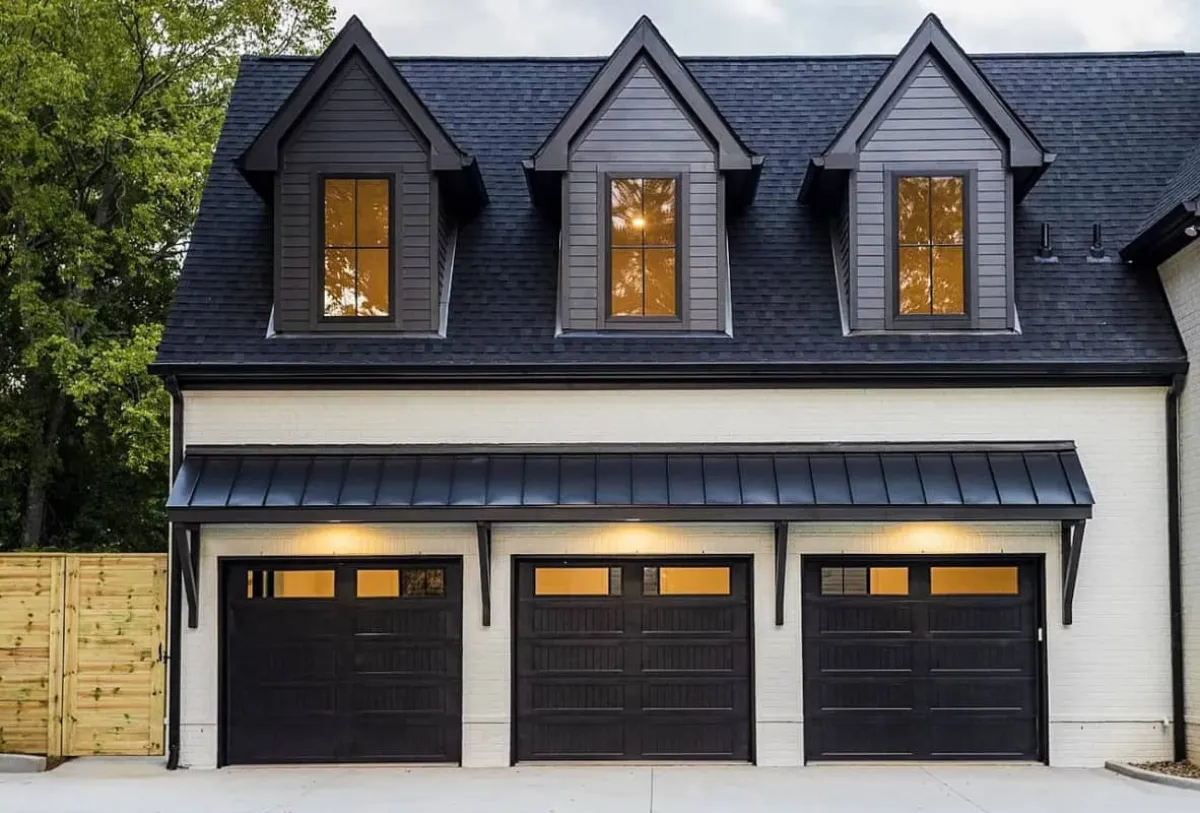
The most expensive mistake I see in new construction? The builder framed the garage opening six inches too narrow for the owner's truck. Sounds small. Costs thousands to fix after the fact.
Happened twice in one year out here. One was a custom build near Tumalo — beautiful property, big house, three-car garage, and the framer used 8-foot openings instead of 9-foot. The homeowner pulls his F-350 in and can't open the driver's door without cracking it into the trim. Two of those openings had to be re-framed after the drywall was up and the siding was on. I don't know the final number on that re-framing bill, but I know it was ugly, and I know it was completely avoidable.
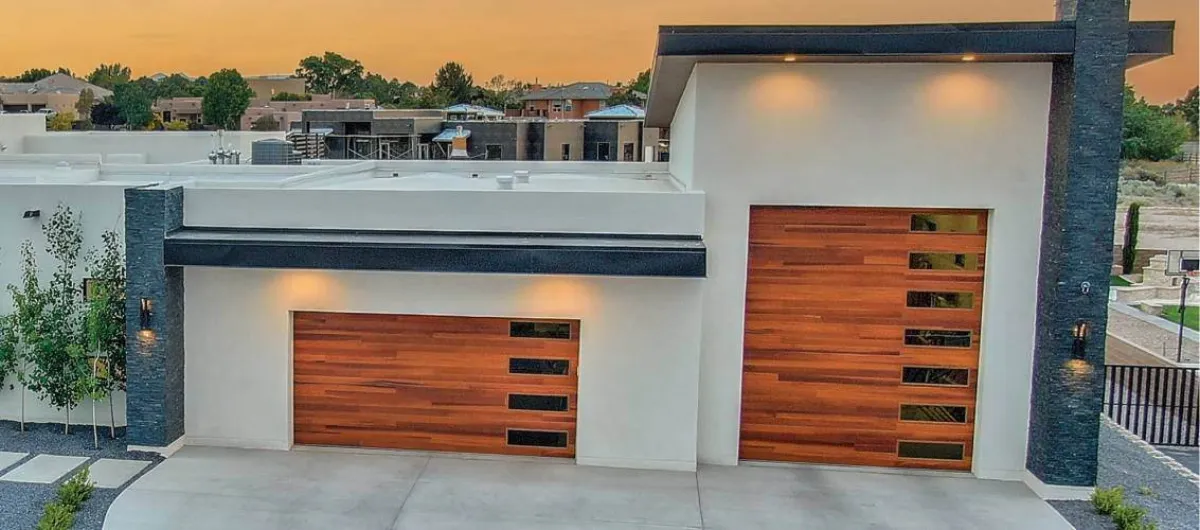
I've been sizing and installing garage doors across Bend, Redmond, Sisters, Sunriver, La Pine, and the rest of Central Oregon since 2016. Thousands of openings at this point. Garage door sizing sounds simple — measure the hole, order the door — and it is simple, right up until somebody gets it wrong. Then it's expensive and frustrating and everybody's mad at everybody else. Here's how to get it right the first time.
Standard Sizes (and Why 9-Foot Is Better Than 8)
Most residential garage doors fall into a handful of standard dimensions. Manufacturers crank these out in volume, which means shorter lead times, more style options, and lower prices than custom. Here's what's common.
For single-car openings, the two standard widths are 8 feet and 9 feet. Heights are either 7 feet or 8 feet. For double-car openings, 16 feet wide is standard, again in either 7-foot or 8-foot height. That's the menu for most residential jobs.
An 8-foot-wide door fits sedans and compact SUVs and not much else with any comfort. A 9-foot-wide door fits trucks, full-size SUVs, and basically every passenger vehicle on the road with room to spare. A 16-foot double fits two cars side by side.
Let me tell you why I push the 9-foot width on everyone who'll listen.
An F-150 is 79 inches wide with mirrors folded. Add mirror clearance and you need 9 feet minimum. That's 6 feet, 8 inches of truck body through an 8-foot opening, which gives you roughly 8 inches of clearance per side. Sounds workable on paper. Now do it in the dark at 6 AM after a twelve-hour shift, in February, with ice on the driveway. One small drift and you're buying a new mirror housing. Or gouging the fender. Or scraping the trim off the door jamb. I've seen all three.
A 9-foot opening gives you about 14 inches of clearance per side with mirrors folded. That's the difference between threading a needle four times a day and just driving into your garage like a normal person.
Same story for the Toyota 4Runner, Chevy Tahoe, Ford Expedition, Tundra with tow mirrors, Tacoma with aftermarket fender flares — basically every vehicle that's popular in Central Oregon is too wide to be comfortable through an 8-foot opening. And this is Central Oregon. People drive trucks. The Subaru Outback might be the state car of Oregon, but in Bend and Redmond, it's F-150s and Tacomas and 4Runners as far as the eye can see. Size the garage for the vehicles people actually own, not the vehicles that fit neatly on a spec sheet.
The price difference between an 8x7 and a 9x7 door is modest. We're talking maybe a hundred bucks on the door itself, give or take, depending on the model. The daily quality-of-life difference is enormous. If you're doing new construction, spec 9-foot singles. If you're replacing an existing door on an 8-foot opening and you can widen it — even if it means a little framing work — that extra foot is almost always worth the investment. If you can't widen it because it's a structural wall or the garage is tight, then we work with what we've got. But given the choice? Nine over eight. Every time.
Now let's talk height. Seven feet has been standard for decades, and it's adequate for sedans and crossovers. It is not adequate for what people in Bend actually drive.
A standard cab pickup runs about 75 inches tall. Throw a roof rack on there for ski season: 80 inches. Add a Yakima cargo box: 84 inches. That's 7 feet flat — zero clearance in a 7-foot opening. A lifted truck with a light bar? You're not making it without modifications to something, and I'd rather it be the garage than the truck.
Eight-foot height is becoming the default in every new subdivision around here — NW Crossing, the newer west side neighborhoods, southeast Bend. Builders figured out that their buyers own trucks and SUVs and that 7-foot doors create problems. The incremental cost of framing for 8-foot height during new construction is almost nothing. Enlarging a 7-foot opening to 8 feet after the house is built means cutting the header, re-framing, re-siding, possibly re-engineering the structural load above the opening. I've seen that retrofit cost ten times what it would have cost to frame it right during construction. Ten times.
For double-car openings: 16x7 is the existing standard in most of Bend's housing stock. New builds are going 16x8. If you're building, go 8-foot height. If you're living with a 16x7 and replacing the door, check whether your headroom allows for an 8-foot door in the existing opening. Sometimes the header position makes it straightforward. Sometimes the framing needs modification. Either way, it's worth asking about.
One more standard-size question that comes up on almost every two-car garage job: two single doors or one double? Both work. Two singles look better — the center post breaks up the visual mass of a big garage face, each door operates independently, and you get more design flexibility. In the neighborhoods where curb appeal matters — Broken Top, NW Crossing, Tetherow, Awbrey Glen — two singles is almost always the right call. Real estate agents will back me up on that.
One double is cheaper. One door, one set of springs, one opener, one installation. Savings can run several hundred dollars when you add up hardware, tracks, springs, and labor. If budget matters more than aesthetics, one double does the job fine. The tradeoff is that a 16-foot slab of door dominates the front of the house. On a ranch-style home with a front-facing garage, it can make the garage look like the main architectural feature. And if the single spring on a double door breaks, the whole thing is down until it's fixed. Two singles means one can still operate while the other's waiting for service.
My general advice: for curb appeal and resale value, two 9x7 or 9x8 singles. For budget projects, one double. If you're on the fence, I can show you examples of both on houses similar to yours around Bend.
Oversized: RVs, Boats, and Central Oregon Toys
This is where Central Oregon diverges from the rest of the country. National sizing guides talk about "standard" and "custom" like those cover everything. Out here, oversized is practically a standard category. People own motorhomes, bass boats, ski boats, snowmobiles, side-by-sides, horse trailers, enclosed car haulers — all the recreational gear that comes with living in a place where the outdoors is the whole point. That stuff needs to go somewhere, and usually that somewhere is a garage, a shop, or a barn with a big door on the front.
Common oversized sizes I install regularly: 10x8 for shop bays and large trucks with trailers. 10x10 for boats on trailers and tall shop equipment. 12x10, which is the most popular shop door size across Central Oregon. 12x12 for Class C RVs and bigger boat-and-trailer combinations. 14x14, which is the most common RV door and handles the majority of motorhomes. And 16x10 for extra-wide shop bays where you need width for equipment plus clearance on both sides.
Let me focus on the ones where the expensive mistakes happen.
RV doors are the big one. If you're building an RV garage or adding an RV bay to an existing property — common in Bend, Sunriver, La Pine, out toward Powell Butte — the door size is the single most important decision in the whole project. Frame it too small and the building doesn't serve its purpose. Period.
A Class A motorhome is 8 to 8.5 feet wide body, 10 feet or more with mirrors extended, and 11 to 12.5 feet tall to the roof. But that roof measurement doesn't include your rooftop AC units — add 12 to 18 inches. Doesn't include the satellite dish. Doesn't include antennas or a luggage rack. With accessories, a Class A can easily hit 13 feet or higher. A Class C is smaller but still typically runs 10 to 11 feet tall with the overcab and AC. A fifth-wheel camper on a truck can reach 13 feet at the highest point of the front cap.
My recommendation for RV bays: 14 feet wide, 14 feet tall. Gives you clearance on all sides, room to walk alongside the RV as you pull in so you can watch the roof and guide yourself, and headroom for accessories you might add later or for your next RV, which will probably be bigger than this one. The cost jump from 12x12 to 14x14 is real — you're talking a larger door, heavier springs, beefier track, more powerful opener, and more structural framing in the opening — but it's a fraction of the cost of tearing out and rebuilding a too-small opening after the concrete is poured and the walls are up.
I've had two calls in my career from people who built RV garages with 12x12 doors and then bought a new motorhome that didn't fit. Both ended up having the opening enlarged. Structural re-engineering, new header, re-framing, re-siding. One was on a finished, painted, landscaped building. Both owners told me the same thing: should've gone bigger from the start. I agree.
Boats and trailers are a different calculation. Width is almost never the problem — most boats are narrow enough. It's height that catches people. The boat itself might be 5 or 6 feet tall. Put it on a bunked trailer and you're at 8 to 10 feet. Larger boats on tandem-axle trailers can push 10 feet. A center console with a T-top or hardtop on a trailer can hit 10 to 11 feet. A wakeboard boat with the tower up on its trailer easily reaches 9 or 10 feet.
The rule: measure your boat on its trailer in storage configuration. Covers on, bimini up if it doesn't fold, outboard tilted up, every accessory attached, tower up if it doesn't fold. Measure to the absolute highest point of the tallest thing sticking up. Not the gunwale. Not the windshield. The very top. Then add a minimum of 12 inches above that and 12 inches on each side. That's your door size. I watched a guy scrape his VHF antenna clean off pulling into a door that was "the right size" based on hull height. Don't be that guy.
For workshops and outbuildings: 12x10 is the sweet spot for most hobby shops and general-purpose bays. Wide enough for a vehicle with working clearance on both sides, tall enough for a truck on jack stands or tall shop equipment. For serious shops, ag buildings, or equipment storage: 14x14. Handles tractors, large enclosed trailers, anything with overhead clearance needs.
One pattern I've noticed over the years: people who size their shop door to exactly what they need right now always wish they'd gone bigger within a couple years. People who go one size up from what they think they need never regret it. You can't easily add inches to a finished opening, but you'll never complain about having too much clearance. When in doubt, go up.
One more thing on oversized doors that people don't always think about: these are not just big versions of residential doors. Everything is heavier-duty. A 14x14 insulated steel door can weigh 500 to 700 pounds. That's three to four times the weight of a standard 9x7. That weight demands heavier torsion springs, larger cable drums, thicker track gauge, a more powerful opener, and structural framing around the opening that can handle the door weight plus wind load plus spring tension. The opener alone needs to be a proper commercial-grade unit — a standard residential opener doesn't have the horsepower to move a 600-pound door reliably.
This is not a weekend project. Not for any skill level. Improperly supported oversized doors are genuinely dangerous. A 600-pound door with a failed spring drops whatever's underneath it. I'm not exaggerating and I'm not trying to scare up business. I'm telling you that the safety margin on oversized installations is essentially zero, and every component needs to be right. Licensed professional, engineered framing, proper hardware. That's the only way to do it.
Measuring It Right
Whether you're replacing an existing door or planning new construction, five measurements matter. I'll tell you what each one is and why I care about it.
Width. Inside edge of one side jamb to inside edge of the other. Measure at the top of the opening and at the bottom. If they don't match — and they often don't, especially in older homes — use the smaller number. That's your actual clear width. In older Bend garages, I regularly see openings that are a half inch wider at the top than the bottom, or vice versa. Settlement, lumber shrinkage, original framing that was a little sloppy. It matters because a door sized to the wider measurement won't fit through the narrower spot.
Height. Floor to the bottom of the header at the top of the opening. Measure on the left side and the right side. Use the smaller number. If the floor slopes — common in older garages where the slab has settled or was poured with intentional drainage slope — measure from the highest point of the floor to the header. I need to know about floor slope before we order the door because it affects how the bottom seal contacts the ground and whether we need a bottom bar adjustment or a threshold seal to close the gap on the low side.
Headroom. This is the distance from the top of the door opening straight up to the ceiling, or to the nearest obstruction above the opening — joists, ductwork, light fixtures, an existing opener rail. Standard track systems need 12 to 15 inches of headroom above the door. Less than 12 inches and we're into low-headroom track territory. Low-headroom hardware works fine, but it costs more and has some operational limitations. This is the measurement that trips people up most often. Most homeowners measuring their own opening either forget it entirely or measure to the ceiling but miss the ductwork or light fixture that hangs down 6 inches lower. Then the installer shows up on job day and the track doesn't fit, and now we're adapting on the fly or reordering hardware. Measure to the nearest obstruction, not just the ceiling.
Sideroom. Distance from each side of the door opening to the nearest wall or obstruction. The vertical tracks need 3.75 to 4.5 inches of clearance on each side. If your walls are closer than that to the edge of the opening, we need special low-sideroom brackets. This measurement gets overlooked constantly. Don't skip it.
Depth (backroom). From the door opening to the back wall of the garage, measured along the ceiling. When the door opens, the panels stack horizontally under the ceiling. You need enough unobstructed ceiling depth to hold the full door plus the opener. A 7-foot-tall door needs roughly 8 to 9 feet of depth behind the opening. An 8-foot door needs 9 to 10 feet. Oversized doors scale up accordingly. If your garage is shallow or the back wall is closer than you'd think — happens in garages that were converted from something else, or older detached garages that are just plain small — this measurement determines whether a standard track layout works or whether we need a special configuration.
Even with all five measurements in hand, I'd rather verify them myself. Half an inch off on any dimension causes problems — a door that binds in the tracks, seals that don't make contact, hardware that won't align with the framing. Professional measurement also catches things that most people miss. Out-of-square openings are incredibly common in older homes — the opening looks square to the eye but it's a half inch or more off when you actually check it with a level and a square. Floor slope that isn't obvious standing up. Ceiling obstructions that you can't see from ground level without climbing up there. Structural conditions behind the drywall that affect hardware options.
We do free on-site measurement as part of every consultation. Takes about fifteen minutes. I bring a laser measure, a level, and a practiced eye for the gotchas. It eliminates the guesswork and means the door we order is the door that fits — first time, no surprises on installation day.
Regarding custom sizes — not every opening matches a standard dimension. Older Bend homes from the 1950s through 1970s have oddball openings all the time. Custom homes in Broken Top, Awbrey Butte, and Shevlin Commons have architecturally unique garage facades. Some buildings were designed for a specific vehicle or use case that doesn't line up with any manufacturer's standard chart.
Most major manufacturers — CHI, Clopay, Amarr — build to custom dimensions in nearly all their residential product lines. The upcharge over a standard size is usually moderate and almost always cheaper than modifying the opening to fit a standard door, which involves framing carpentry, possibly structural work, new trim, and finishing. Arched tops for Mediterranean or Craftsman homes, extra-wide singles, non-standard heights like 7'6" or 8'6", oversized residential-quality doors for shops that need to match the house — all doable as custom orders. Lead time runs three to five weeks from order, sometimes longer during peak season. If you're planning anything custom, start the conversation early. Spring and summer are our busiest periods and production lead times stretch out.
Call Brokentop Garage Doors at 541-203-7676 to schedule a free measurement. I'll come out, take precise measurements, walk through your vehicle and storage needs, and recommend the right door size for your situation. Practical advice, no pressure, no charge. Just a tape measure, a conversation, and an answer you can trust.
For more on the installation process, visit our garage door installation page. For non-standard openings, check out custom garage door options. We serve Bend, Redmond, Sisters, Sunriver, La Pine, Prineville, Madras, Tumalo, Terrebonne, Powell Butte, and everywhere else in Central Oregon.
Tyler and Ashley Ottesen own Brokentop Garage Doors, licensed in Oregon (CCB #209697). Tyler has over a decade of experience sizing, installing, and repairing garage doors of every kind — from standard residential replacements to oversized RV doors to custom architectural jobs across Central Oregon.