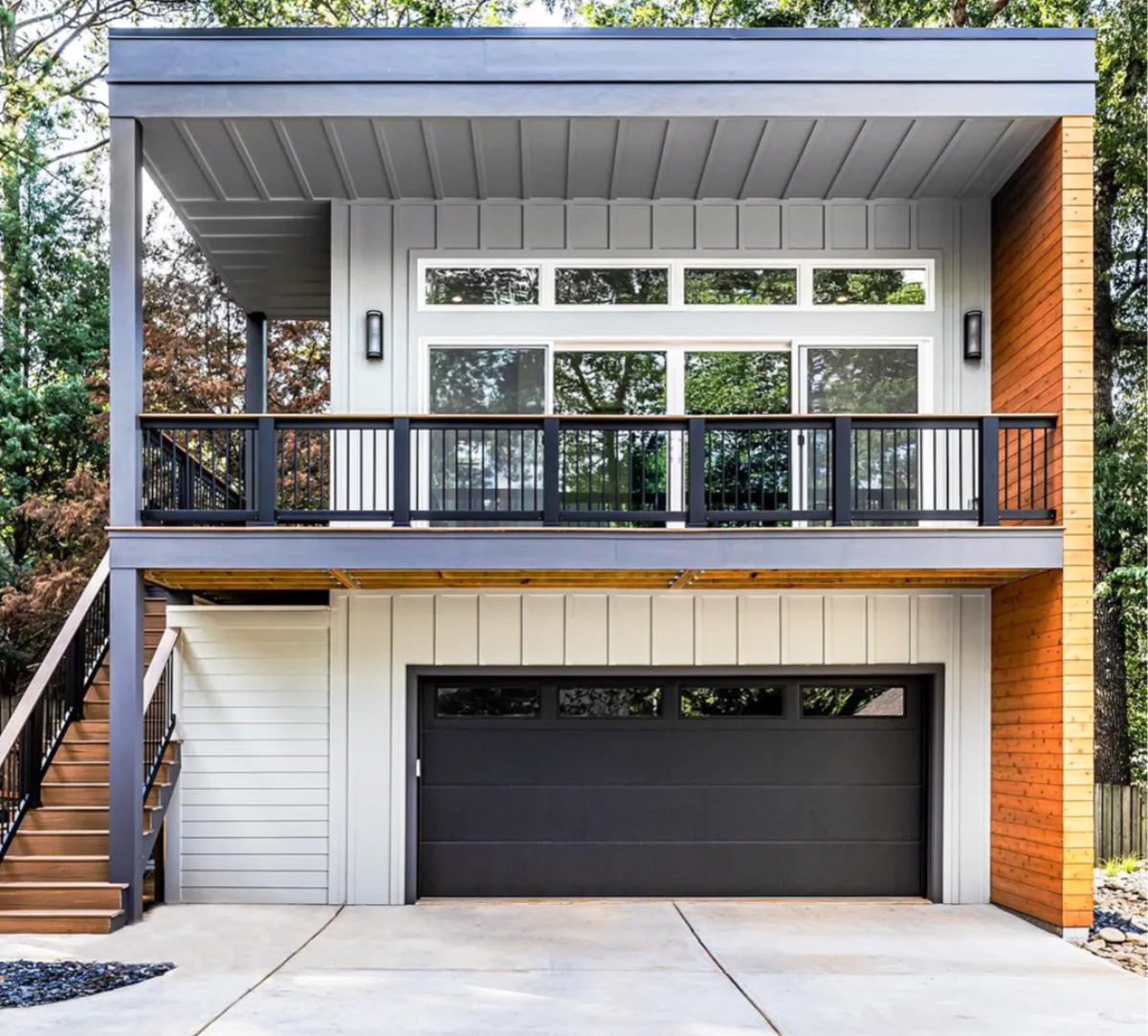
People ask me all the time — "should I repair this thing or just get a new one?" And my honest answer, about 60% of the time, is repair it.
That surprises people. They expect me to push the replacement because, yeah, a new door is a bigger sale. I get why they'd think that. But here's the deal: I've been doing this in Bend for over ten years. I run into the same homeowners at the grocery store, at the kids' soccer games, at Worthy Brewing on a Friday night. If I sell somebody a door they didn't need, that gets around. So when someone asks me the repair-or-replace question, I actually think about it. I walk through the same mental checklist every time, and I'm going to lay that out for you here.
Not a bullet-pointed "10 Signs You Need a New Door" list — that's what every other website gives you. What I want to share is how I actually evaluate a door when I'm standing in someone's driveway in Redmond or Sisters or out on a ranch property in Powell Butte. The thought process. Because once you understand how a garage door guy thinks about this, you can look at your own door and get pretty close to the right answer without even calling anybody.
The First Thing I Look At (And It's Not What You'd Guess)
Most people assume I start by inspecting the broken part — the spring that snapped, the panel that's dented, whatever triggered the call. I don't. The first thing I look at is the age sticker.
Every garage door has a manufacturer label somewhere on it, usually on the inside of one of the upper panels or on the vertical track bracket. That label tells me the manufacturer, model, and — if I'm lucky — the date of manufacture. Sometimes there's no date, and I have to estimate based on the model number and when that particular line was in production. I've been doing this long enough that I can usually ballpark it within a couple of years just by looking at the hardware style.
Why does age matter so much? Because a garage door is a system of components that all age together. The springs, the cables, the rollers, the hinges, the seals, the panels — they were all installed at the same time, and they all have a finite lifespan. When one major component fails on a 22-year-old door, the rest of that system is operating on borrowed time. I might fix your spring today, but there's a real chance your cables are going to go in four months, and your rollers six months after that. Each repair is individually reasonable, but collectively you're bleeding money keeping a door alive that's past its designed life.
Here's my rough mental framework on age:
Under 10 years old: Almost always repair. Unless somebody backed into it with a truck and destroyed three panels, a sub-10-year-old door has plenty of life left in its components. Fix the thing that broke and move on with your life.
10 to 15 years: Depends on the issue and the door's overall condition. A single broken spring on a well-maintained 12-year-old door? Repair, easy call. Multiple problems stacking up on a door that hasn't been maintained? That's where it gets interesting, and I start looking harder at the other factors I'm about to describe.
15 to 20 years: I'm leaning toward replacement for anything beyond a minor fix. At this age, the door is in the back half of its useful life even under the best circumstances, and in Central Oregon's climate — where we get those brutal freeze-thaw cycles all winter — 15 years of our weather is equivalent to about 20 years somewhere with milder conditions.
Over 20 years: I'm almost always recommending replacement regardless of what brought me out there. A 20-plus year old door in Bend has been through over 200 freeze-thaw cycles, thousands of temperature swings from single digits to 95 degrees, and roughly 30,000 open-close cycles. Everything is worn. The question isn't whether more things will fail — it's when and how much you'll spend chasing each failure.
The Second Thing: What Broke, and Is It an Isolated Problem?
After age, I'm looking at the specific failure and trying to figure out whether it's a one-off or a symptom of broader wear.
A broken torsion spring on a 7-year-old door? That's a one-off. Springs have a cycle life rating — most residential springs are rated for 10,000 cycles, and a door that gets opened and closed four times a day hits that in about seven years. The spring did its job, it reached end of life, you replace it. The rest of the door is fine. Takes me about an hour, and you're good for another seven-plus years on the new springs. No-brainer repair.
But a broken spring on a 16-year-old door where I also notice the cables are fraying, the bottom seal is shredded, and two rollers are grinding? That's not an isolated failure — that's a system telling me it's done. I could replace the spring and send you a bill, and you'd be happy for a few months. But I'd be back. And back again. And by the time we'd chased every failing component, you'd have spent close to what a new door costs, except you'd still have old tracks, old panels, and old everything else.
Here's what I consider isolated (usually repair-worthy) problems:
- A single broken spring on an otherwise healthy door
- One damaged panel from an impact (car door, basketball, tree limb)
- A noisy roller or two that need replacing
- Sensor alignment issues
- Opener malfunction (the opener is separate from the door itself)
- A worn-out bottom seal
And here's what tells me the door as a whole is declining:
- Multiple components failing within the same 12-month stretch
- Panels warping or bowing (especially common in Bend's temperature extremes)
- Tracks that are bent, rusted, or pulling away from the wall
- Hardware that's corroded throughout, not just in one spot
- A door that's gotten progressively noisier despite lubrication
- Gaps along the sides or bottom that you can see daylight through
The Money Question: My 50% Rule
At some point in every repair-vs-replace conversation, we have to talk dollars. And I have a simple rule I've used for a decade that has never steered anyone wrong: if the repair costs more than half what a comparable new door would cost, replace it.
I stole this from auto mechanics, honestly. It's the same logic — if your engine repair costs more than half the car's value, you buy a different car. Works the same way with garage doors.
Let me walk through a real example. Say you've got a 17-year-old single-layer steel door. Two panels are warped from years of Bend's temperature swings, and a spring broke. Replacing two panels and a spring on this door is going to run a significant chunk of money. A brand new insulated door — with new springs, new hardware, new seals, warranty, and actual insulation — isn't dramatically more. You'd be putting good money into a 17-year-old uninsulated door when, for not that much more, you get a completely new system that'll last another 20 years and actually keep your garage warm in winter.
On the flip side: a broken spring on a 5-year-old CHI insulated door? That repair is a fraction of what a new door costs. Repair it, no question. The door has 15+ years of life left.
I always give people both numbers. Here's what the repair costs, here's what replacement would cost. I let them do the math. I never push one over the other, because the right answer depends on the specific situation, and the homeowner knows their budget and priorities better than I do.
The Insulation Factor (This One's Bend-Specific)
This is where my advice for a Bend homeowner diverges from generic internet advice. If your existing door has no insulation — it's a single-layer steel door or bare wood panels — that alone can tip the scale toward replacement even if the door is mechanically functional.
I know that sounds self-serving. "Garage door guy says you should buy a new door." But hear me out.
An uninsulated garage door has an R-value near zero. A modern polyurethane-insulated door — like the CHI 4200 series we install more than anything else — delivers R-16 to R-18. In Bend, where we get weeks of sub-20-degree mornings and the heating season runs from October through April, that's a massive difference. Your garage shares walls and often a ceiling with your living space. An uninsulated garage door is basically a 128-square-foot hole in the side of your house.
I've had customers in NW Crossing and Awbrey Butte tell me their attached garage went from "meat locker cold" to "comfortable workspace" after we replaced an old uninsulated door with an R-16 insulated one. Several have told me they noticed a real dip in their heating bills. I can't give you an exact dollar figure because it depends on your home's layout, your heating system, and how you use the garage — but I've yet to have a single customer tell me they regretted the upgrade. Not one in ten years. For the full breakdown on insulation values and what they mean in our climate, I wrote a separate piece on that: garage door insulation guide for Bend.
The Safety Check I Do on Every Door
This one isn't negotiable for me. When I'm evaluating a door, I test the safety systems. If the door predates 1993 — and yes, there are still pre-1993 doors operating in Bend, I see a few every year — it almost certainly lacks modern safety features. Federal law has required auto-reverse mechanisms since '93, but some older doors were never retrofitted.
Here's what I'm testing:
Photo-eye sensors. Those two little sensors at the bottom of the door opening, about six inches off the ground. They shoot an infrared beam across the opening. If anything breaks that beam while the door is closing — a kid, a dog, a bicycle — the door stops and reverses. If your door doesn't have these, or they don't work, that's a safety issue I'm flagging immediately.
Auto-reverse on contact. Even with photo-eyes, the door should reverse if it contacts resistance while closing. I test this with a 2x4 laid flat on the ground under the door. The door should reverse within two seconds of contacting the board. If it doesn't, the force settings are wrong or the mechanism isn't working.
Manual release. The red handle hanging from the opener rail. If the power goes out — and it does go out in Bend, every winter — you need to be able to disconnect the door from the opener and operate it manually. If that release is jammed, rusted, or the door is too heavy to lift manually because the springs are worn, that's a problem.
If a door is missing basic safety features and it's also old enough to be having mechanical issues, replacement isn't just my recommendation — it's the responsible call. Modern doors and openers include photo-eyes, auto-reverse, rolling code technology (so nobody can copy your remote signal), and many now include battery backup for power outages. For more on safety features, check out our guide on garage door safety for families.
What I Think About That Nobody Asks Me About: Curb Appeal and ROI
Homeowners rarely bring up curb appeal during the repair-or-replace conversation. They're thinking about whether the door works, not what it looks like. But I think about it, because I've seen the data and I've seen the results firsthand.
Your garage door is roughly 30% of your home's front-facing exterior. That's not a made-up marketing number — go stand across the street from your house and look. The garage door is the single largest visual element on most home facades. When a homeowner puts $40,000 into new siding and paint and landscaping and still has a faded, dented, 1998 garage door... it's like wearing a tailored suit with beat-up sneakers. Everything else looks great, and then your eye goes right to the thing that doesn't match.
And here's the kicker: according to Remodeling Magazine's Cost vs. Value report, a garage door replacement returns 90 to over 100% of its cost at resale. It's consistently one of the highest-ROI home improvements you can make. Higher than a kitchen remodel. Higher than a bathroom renovation. Higher than a new deck. If you're thinking about selling your home in the next few years — and in Bend's real estate market, a lot of people are — a new garage door is one of the smartest investments you can make.
So when I'm looking at a door that's functional but ugly — faded color, outdated style, visible dents and patches — and the homeowner tells me they're thinking about selling in the next couple of years? I mention the ROI data. Not to make a sale, but because it's genuinely useful information that most people don't know.
My Decision Framework, Summarized
Here's the thought process distilled down. This is literally what runs through my head when I'm standing in your garage looking at your door:
| What I'm Evaluating | Leans Toward Repair | Leans Toward Replace |
|---|---|---|
| Age of door | Under 12-15 years | Over 15, especially over 20 |
| Nature of failure | Single component, isolated | Multiple components, systemic |
| Repair cost vs. new door | Under 50% of replacement | Over 50% of replacement |
| Insulation | Door is already insulated | No insulation (single-layer) |
| Safety features | Photo-eyes, auto-reverse work | Missing or non-functional |
| Repair history (12 months) | First repair call | Third or more repair call |
| Visual condition | Looks fine, normal wear | Warped, faded, multiple dents |
| Homeowner plans | Staying in home long-term | Selling within 2-3 years |
If I'm seeing three or more factors in the "replace" column, that's almost always where I land. If most factors are in the "repair" column, we fix what's broken and call it a day. The gray area is when you've got two or three in each column — and that's where the conversation with the homeowner matters most, because their budget, timeline, and priorities factor into a decision that the numbers alone can't make.
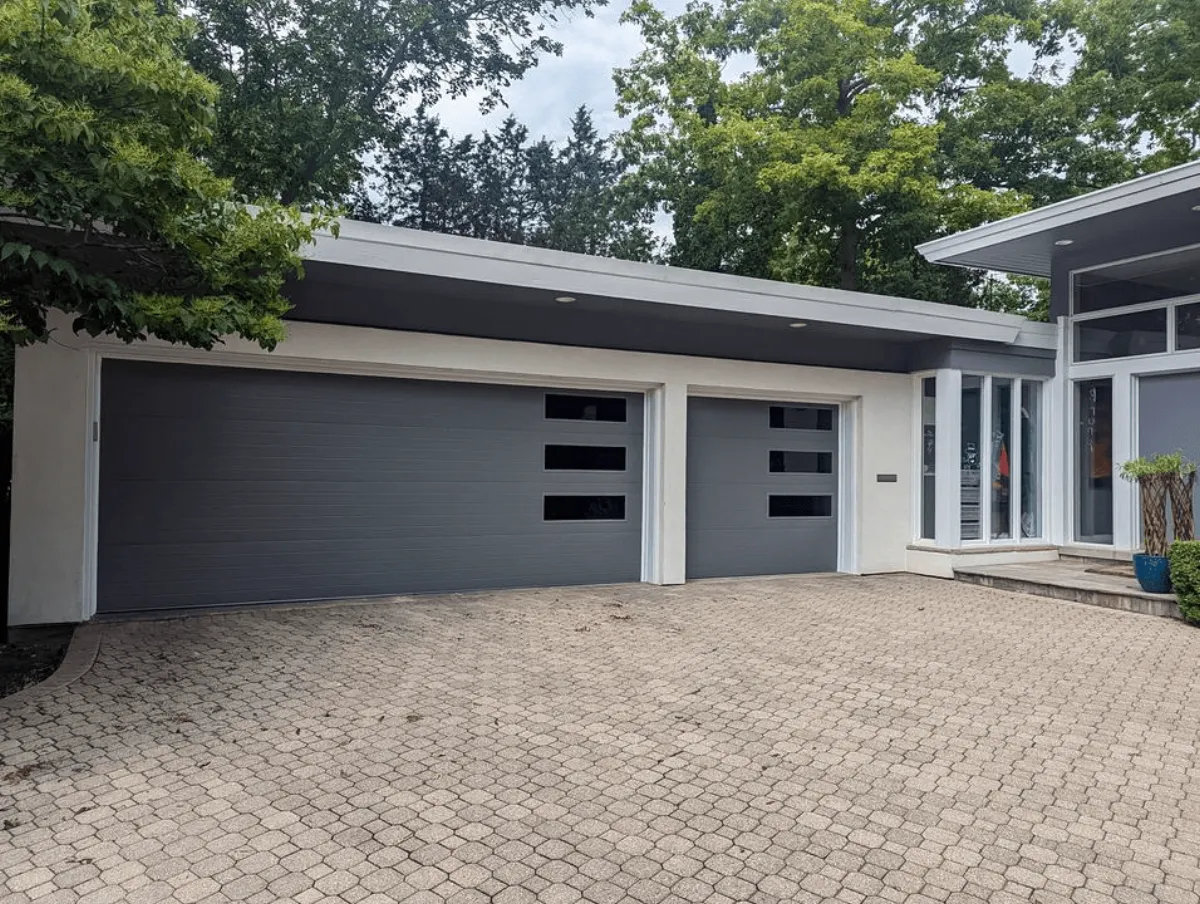
Alright, So You're Replacing — What Does That Actually Look Like?
If you've worked through all that and landed on replacement, here's what happens. I'm spelling this out because most people have never replaced a garage door and don't know what to expect. I hate surprises on jobs, and I assume my customers do too.
Step 1: I Come Look at Your Door
Free consultation, takes about 20 minutes. I measure the opening — width, height, headroom above the opening, sideroom on each side, depth of the garage. I look at the existing tracks, the header structure, and the ceiling clearance. I check whether your current opener can work with a new door or whether it should be replaced too (usually if the opener is over 10 years old and we're putting on a new door, I suggest replacing both — the opener motors are at the same life stage as the door components). Then we talk about what you want and I give you an honest recommendation, including telling you if repair makes more sense. No charge for any of this.
Step 2: You Pick Your Door
Style, insulation level, color, windows, hardware. I can show you samples and catalogs, and I have a digital tool that can superimpose different door styles onto a photo of your actual house so you can see what each option looks like before you commit. Most Bend homeowners end up choosing from a few options I see over and over:
- CHI 4200 Series — Our most-installed door in Central Oregon. Three-layer steel, polyurethane insulation, R-16. Raised panel, flush, or long panel styles. Wide color range. This is the workhorse door that does everything well at a reasonable price point. It's what I have on my own house.
- Clopay Canyon Ridge — For the wood-look carriage house style without actual wood maintenance. Faux wood composite over insulated steel. We install a lot of these in Broken Top, Tetherow, and NW Crossing where HOAs want that upscale look. Holds up beautifully in our UV-intense, freeze-thaw climate where real wood would need refinishing every two or three years.
- CHI 5200 Series — Insulated steel with decorative overlays for a carriage house appearance. Wood-grain finishes that look like walnut, cedar, or mahogany. Same R-16 insulation as the 4200, just with the upgraded aesthetic. Meets HOA guidelines in virtually every Bend planned community.
- Amarr Stratton — Honest, well-made, budget-friendly insulated door. Polyurethane insulation, solid construction, handles Bend's climate without complaint. Great for rentals, new construction on a budget, or anyone who wants performance without paying for decorative upgrades they don't care about.
For a deeper dive into all these options plus more, I wrote a separate piece: best garage doors for Bend, Oregon. And if you're specifically weighing steel against wood, there's this one: steel vs. wood garage doors for Bend.
Step 3: We Order and Wait
Standard doors, three to five weeks typically. Custom sizes, colors, or configurations, four to eight weeks depending on the manufacturer. I tell you the real timeline upfront — I'm not going to promise two weeks and then stall for six. If there's a delay from the manufacturer, I let you know as soon as I know.
Step 4: Installation Day
We show up with everything: the door, the springs, the hardware, the seals, and any opener components if we're replacing that too. Here's the sequence:
- We take down your old door carefully — it's heavy and the springs are under tension, so this is methodical, not rushed.
- We inspect the tracks, brackets, and header structure. If anything needs reinforcing or replacing, we handle it.
- New panels go up section by section, bottom to top.
- New springs, sized and rated specifically for your new door's weight and size.
- Opener connection and programming — we set the travel limits, adjust the force settings, and program your remotes.
- Full safety testing: photo-eyes, auto-reverse with a 2x4 test, manual release.
- Walk-through with you — how to operate it, basic maintenance, what the warranty covers, who to call if anything seems off.
Most standard residential replacements take four to six hours. Your garage is never left open overnight. We haul away the old door and recycle what we can — steel, aluminum, and hardware are all recyclable.
A Couple of Real Situations from the Last Year
I want to give you a sense of how this plays out in practice, because abstractions only go so far.
The Redmond ranch house: Customer called about a broken spring on a 14-year-old door. I got there and the spring was definitely snapped, but the door itself was in solid shape — it was a decent quality insulated door that had been reasonably maintained. No warping, no other components showing wear, good seals. I replaced the spring. Told them they'd probably get another 6 to 10 years out of the door before replacement made sense. Bill was a fraction of what a new door would have cost. That's the kind of repair call I feel good about.
The Awbrey Butte remodel: Homeowner had just completed a gorgeous exterior renovation — new siding, new paint, new landscaping, new front door. The garage door was a 19-year-old single-layer steel door, no insulation, faded white, with two dented panels and one roller that was grinding. Mechanically, it still worked. I could have replaced the roller and panels and sent them a bill. But I pulled up the Cost vs. Value data and showed them the ROI numbers for garage door replacement. They ended up going with a CHI 5200 in a dark bronze finish that complemented their new exterior. The transformation was dramatic — the house went from "nice remodel, ugly door" to "this whole property looks incredible." They sent me a photo after the landscaping was finished and I use it in my portfolio now, with their permission.
The Tumalo outbuilding: Customer had a detached shop with a 12x10 oversized door that was about 18 years old. One spring broke and a couple of cables were fraying. But the door was a heavy-duty commercial-grade unit that had been well-maintained, and the panels were in great shape. No insulation needed because it was an unheated workshop. I replaced the springs and cables. That door probably has another 10 years in it. Replacement would have been overkill.
Three different situations, three different answers. That's why there's no one-size-fits-all answer to the repair-or-replace question — you have to look at the whole picture.
The Bottom Line from Someone Who Does This Every Day
Most doors should be repaired. I mean that. If your door is under 15 years old and has a single specific problem, fix the problem. Don't let anyone talk you into a replacement you don't need.
But when a door is old, worn out, uninsulated, missing safety features, or costing you more in repairs than it's worth — replacement isn't just the smart financial move, it's a genuine upgrade to your home. Better insulation, better safety, better curb appeal, better resale value, quieter operation, warranty coverage. It resets the clock on everything at once.
If you're not sure where your door falls, call us. I'll come look at it, give you my honest opinion, and give you both numbers — repair and replace — so you can make the call yourself. No pressure, no obligation. That's how Ashley and I have always run this business, and it's why people in Bend keep calling us back.
Call Brokentop Garage Doors at 541-203-7676 to schedule a free consultation. We serve all of Central Oregon — Bend, Redmond, Sisters, Sunriver, La Pine, Prineville, Tumalo, Terrebonne, Powell Butte, and everywhere in between.
You can also check out our garage door installation page if you're already leaning toward replacement, or browse our full range of services if you're still figuring out what you need.
Tyler and Ashley Ottesen own and operate Brokentop Garage Doors, licensed in Oregon (CCB #209697). Tyler has 10+ years of hands-on experience in garage door repair, installation, and maintenance across Central Oregon, and is a CHI Master Installer and LiftMaster Certified Installer.